
Blog
Atomic absorption spectroscopy (AAS) turns metal analysis from a specialist chore into a routine, element-specific measurement. By measuring how atoms in a vaporized sample absorb light at characteristic wavelengths, an AAS system reports the concentration of lead, cadmium, arsenic, mercury and dozens of other metals down to trace levels. That precision is exactly what environmental monitoring and food safety programs depend on, because both fields are governed by strict metal limits and need results that survive regulatory scrutiny.
At its core, AAS isolates one element at a time. A hollow-cathode lamp emits light at that element's resonance wavelength, the sample is atomized in a flame or graphite furnace, and the instrument records how much light is absorbed. The absorbed amount follows Beer-Lambert behaviour, so it maps directly to concentration. Because each element uses its own lamp and wavelength, the method is highly selective, with fewer interferences than broad-spectrum techniques such as UV spectrophotometry. Our spectrophotometer range covers both single-element and routine multi-element screening needs.
The appeal for monitoring and food labs is consistency. Once a method is validated for an element and matrix, the same procedure runs day after day with minimal operator skill, which is why AAS remains a default choice even where newer instruments exist. Browse our atomic absorption spectrometer range to see how the platform is packaged for routine use.
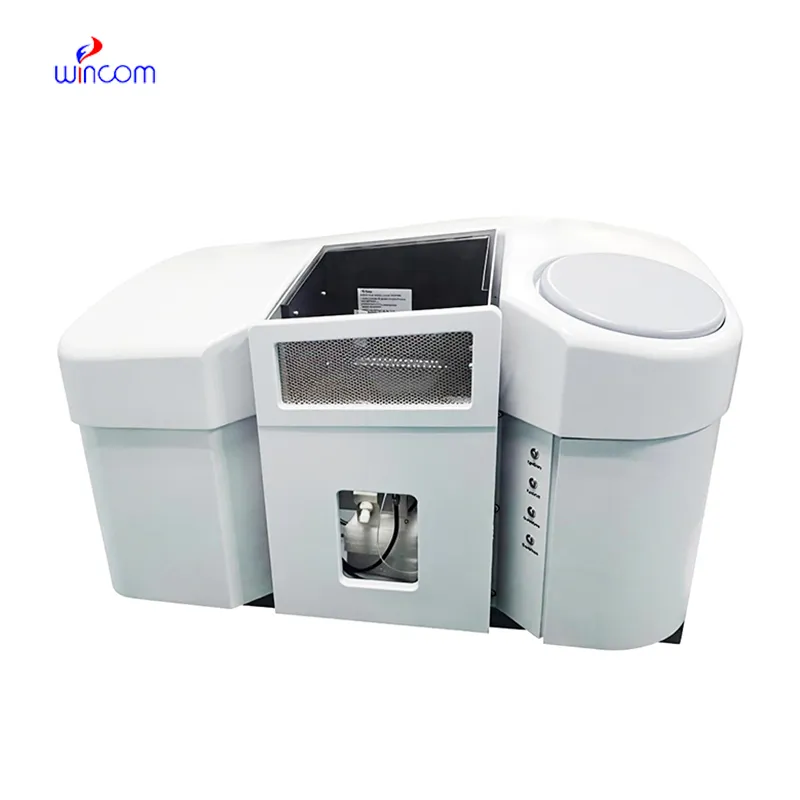
Environmental programs use AAS across every matrix that can carry metals into people and ecosystems. The method is valued because it is robust, affordable per test, and well documented in standard methods such as EPA and ISO procedures. The task is the same everywhere: confirm that a sample sits below the legal or guideline limit before water is released, land is reused, or air is declared safe.
Trace detection is the hard part. Many environmental and food limits sit at parts per billion or below, where a graphite furnace and careful preparation decide whether a lab can even report a number. That is where a well-set-up AAS bench pays for itself, and our AAS instruments are built around that routine.
A reliable environmental result depends less on a single reading and more on a repeatable workflow. The checklist below keeps routine screening defensible.
Food safety authorities worldwide limit heavy metals because they accumulate in the body and harm development, kidneys and nerves. AAS is a front-line tool for incoming-material checks, finished-product release and incident investigation, and it pairs well with the analytical balances and digestion equipment already on a food lab bench.
Where AAS stands out is throughput: a single evening of prepared digests can clear dozens of lots against their limits, which keeps release decisions fast without sending every sample to an external laboratory.
Food matrices vary more than water, so the plan below keeps screening consistent across ingredients and origins.
A single AAS platform can serve environmental and food workflows once the right lamp, atomization mode and calibration are in place. For teams comparing techniques, our article on the advantages of AAS over other analytical methods explains where it wins on cost, simplicity and selectivity.
⭐ Recommended Atomic Absorption Spectrophotometer | Wincom AAS-320
Wincom AAS-320
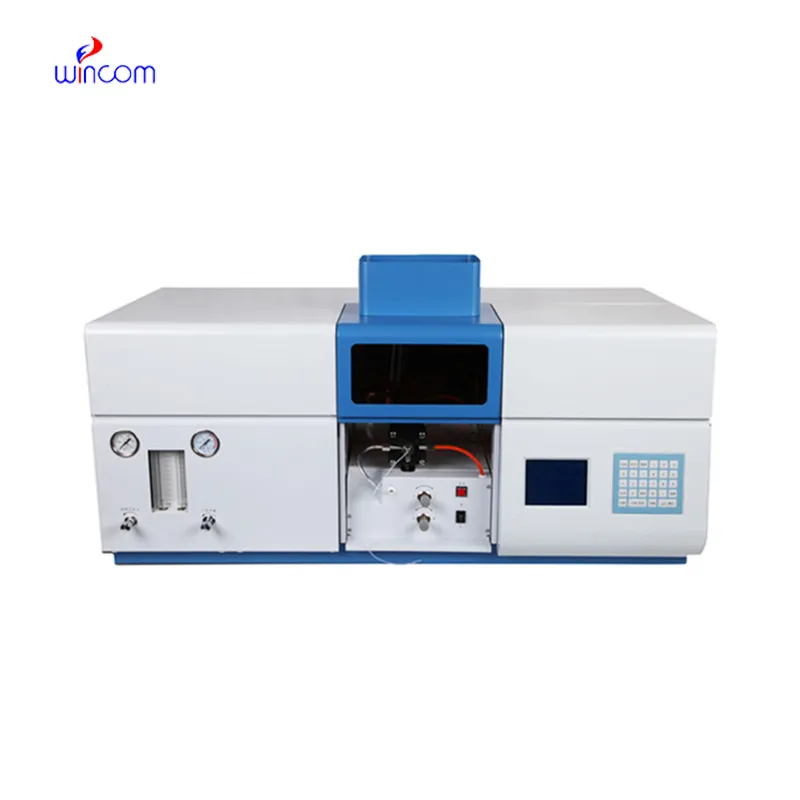
Wincom's Atomic Absorption Spectrophotometer AAS-320 is positioned for environmental and food-safety screening, with a 190-900 nm working spectral range, wavelength accuracy of plus or minus 0.5 nm, baseline stability of plus or minus 0.004 Abs per 30 min, and six selectable spectral bandwidths from 0.2 nm to 5.0 nm. A single lamp stand supports flame work, while an optional graphite furnace extends it to trace-level determination of lead, cadmium, arsenic, mercury and other regulated metals. This makes it suitable for water, soil, food and supplement labs that need dependable, standards-based metal analysis without a complex workflow.
An AAS result is only as good as the preparation around it. A complete bench pairs the spectrometer with a few supporting instruments, and most of them already sit in a general laboratory.
Yes. The same instrument handles liquid digests from water, soil and food once the right lamp, atomization mode and calibration are selected. The optional graphite furnace is what brings food and soil traces into measurable range.
Flame AAS is faster and cheaper for higher concentrations such as nutrients and some effluent limits. Graphite furnace AAS reaches the low-ppb levels required for drinking water, rice arsenic and seafood mercury. Many labs start with flame and add the furnace later.
Use certified reference materials, run blanks and spikes, calibrate across the expected range, and keep the instrument maintained. Document each step so the result can be audited against the applicable standard method.
Visit the AAS-320 product page for the full specification, or browse the AAS category and spectrophotometer range. Our team can also advise on flame, furnace and accessory combinations through the contact channel.
Need help specifying an AAS setup for your lab?
Tell us your target metals, sample matrices and required detection limits. Wincom will recommend the AAS-320 configuration, furnace option and the supporting balance, digestion and safety equipment for a compliant workflow.
Or review the Wincom AAS-320 and browse all atomic absorption spectrophotometers or the wider spectrophotometer range.
E-mail: [email protected]
Tel: +86-731-84176622
+86-731-84136655
Address: Rm.1507,Xinsancheng Plaza. No.58, Renmin Road(E),Changsha,Hunan,China


 EN
 af
 es
 ar
 tr
 sw
 pt
 th
 ur
 bn
 ne
 vi
 km
 lo
 de
 ru
 fi
 nl
 fa
 fr
 ko


