
Blog
There are significant differences between biological and optical microscopes in lens configuration and design, observation range and applicability, special accessories and functions, and price and operation. Here are some differences between the two microscopes.
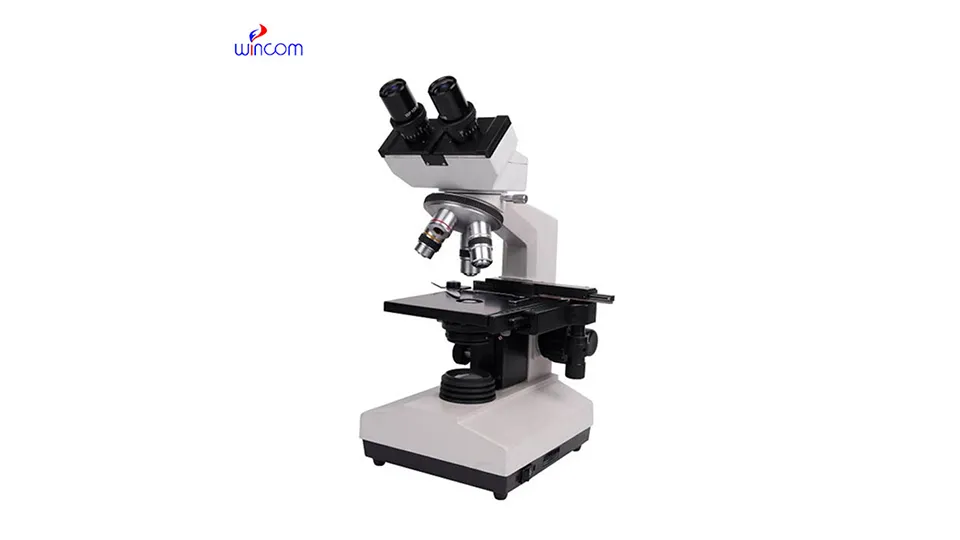
Biological microscopes are usually equipped with multiple objective lenses and eyepieces. These lenses can be used in combination to achieve high magnification and clarity. Optical microscopes usually have only one objective lens and one eyepiece, which are mainly used for low-magnification observation.
The design of biological microscopes usually includes inverted or upright to adapt to biological samples of different sizes, especially when observing in a petri dish. In contrast, optical microscopes generally have a vertical design and are mainly used to view samples placed on glass slides.
Biological microscopy can observe biological samples such as cells, tissues, bacteria, and viruses. Its resolution and magnification are high, and it can clearly see the fine structures inside cells, such as organelles, DNA, RNA, etc. Although optical microscopes can also observe microscopic objects, their resolution is relatively low and are more suitable for observing non-biological samples such as metals, minerals and ceramics.
Biological microscopy has a wide range of applications in the field of biology, including cell biology, histology, microbiology, etc. Optical microscopes are used in both scientific research and medical fields due to their wide applicability, but are more focused on observing the static structure of fixed samples.
Commonly used accessories for biological microscopes include polarizers, interferometers, and multispectral filters, which help provide more accurate colors and richer details. Optical microscopes, on the other hand, usually use coarse and fine adjustment devices to adjust the focus and magnification.
Modern biological microscopes are often equipped with image processing functions that can digitally process and analyze observed cell images. Optical microscopes rely more on traditional observation methods, but their functions can also be expanded by adding accessories such as digital imaging equipment.
Because biological microscopes are equipped with more complex optical systems and more expensive parts, their prices are usually higher than optical microscopes. The optical system of optical microscopes is relatively simple and the manufacturing and maintenance costs are low, so the price is more affordable to the people.
Optical microscopes usually require both hands to operate, while biological microscopes can be operated with one hand. In addition, biological microscopes also support the use of digital cameras for observation, further improving the convenience of operation.
E-mail: [email protected]
Tel: +86-731-84176622
+86-731-84136655
Address: Rm.1507,Xinsancheng Plaza. No.58, Renmin Road(E),Changsha,Hunan,China


 EN
EN
 af
af
 es
es
 ar
ar
 tr
tr
 sw
sw
 pt
pt
 th
th
 ur
ur
 bn
bn
 ne
ne
 vi
vi
 km
km
 lo
lo
 de
de
 ru
ru
 fi
fi
 nl
nl
 fa
fa
 fr
fr
 ko
ko


