
Blog
A practical maintenance and sterilization protocol for operating tables separates three jobs: routine cleaning after every case, disinfection of all patient-contact surfaces between patients, and periodic sterilization of only the components the manufacturer certifies as sterilizable. Done on a fixed schedule it protects patients, keeps mechanical adjustments accurate, and gives infection-control auditors the records they expect. The steps below apply to manual and electro-hydraulic tables alike.
A sterile instrument touches a clean but not sterile table every day, so the table itself is normally disinfected, not sterilized. Cleaning removes soil with a neutral detergent. Disinfection reduces pathogens on surfaces to a safe level using a hospital-approved agent. Sterilization, which destroys all microbial life, is reserved for components that are removable and certified to survive the process, such as certain pads, rails, or accessories. Assuming the whole table can be autoclaved is a common and costly mistake: heat and moisture damage hydraulic seals, electronics, and bonded upholstery.
Where the line falls between disinfection and sterilization is also a documentation question. Infection-control standards expect the theatre to record which surfaces were disinfected, with which agent and lot, and on what schedule; sterilization, when used, is logged as a separate process with its own validation. Mixing the two in one undocumented step is how a facility loses traceability during an outbreak investigation.
A repeatable sequence keeps every case safe and shortens audit preparation:
Keep the sequence identical across staff and shifts. Variation, not the agent, is the most common reason a theatre fails a surface swab during inspection.
Adjustment accuracy drifts when joints, locks, and actuators are neglected. On a weekly cycle, exercise every section through its full range and confirm it holds position under load. For a table such as the Wincom WN3003, the public specification lists a back section of 60 degrees up and -20 degrees down and a leg plate that tilts at least 90 degrees, with a minimum floor height of 750 mm; a monthly check should confirm those movements still engage and lock without creep. Lubricate pivots only with the lubricant named in the manual, because the wrong grease attracts dust or attacks seals. Tighten accessible fasteners to the stated torque and replace cracked or hardened pads before they trap fluid.
Watch two failure modes in particular. Fluid that reaches a hydraulic or electric actuator can cause intermittent position loss that looks like user error, so wipe spill paths immediately and confirm connectors are dry before use. Pad adhesion and seam integrity also degrade with aggressive disinfectants; a pad that lifts at the edge traps rinsate and becomes a reservoir, so replace it on the maintenance schedule rather than at the first visible stain.
Maintenance load is set at purchase. Fewer seams, sealed pad edges, detachable and smooth-surfaced components, and accessible adjustment points cut cleaning time and lower infection risk. When comparing models, ask which parts are removable for separate processing and which disinfectants the surfaces are rated for.
There is a real trade-off between a low purchase price and lifetime maintenance cost. A simpler manual table such as the WN3003 is inexpensive to service because it has few actuators to fail, but it shifts more adjustment effort onto staff. An electro-hydraulic table reduces physical load yet adds power, control, and fluid systems that need their own checks. Choose on procedure volume and who performs adjustments, not on headline features.
⭐ Recommended
Ordinary Operation Table | Wincom WN3003
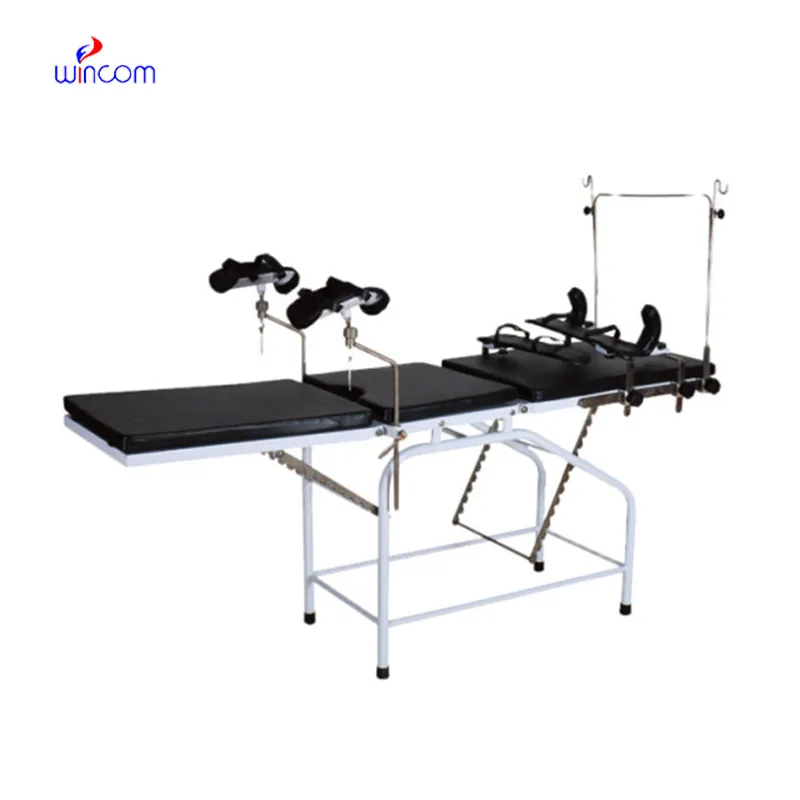
Wincom's Ordinary Operation Table WN3003 is positioned for general surgical and examination use, with an overall length of 2000 mm, a 480 mm table top, a minimum floor height of 750 mm, a back section adjustable to 60° up and -20° down, and a leg plate that tilts at least 90°. Its straightforward mechanical layout keeps service points accessible, which helps a routine cleaning and adjustment schedule stay practical in a busy theatre.
Not every approved surface disinfectant is safe for every table. Upholstery, stainless steel, anodized parts, and plastics each tolerate different agents; peracetic acid, chlorine, and quaternary ammonium compounds can dull, craze, or weaken some materials if used undiluted or left too long. Ask the supplier for the documented compatibility list for the exact model and batch, and train staff to mix and rinse per that list. A one-line 'use standard disinfectant' instruction hides a real failure mode that shows up only after pads discolor or seals swell.
Log the agent, dilution, lot, and contact time with each session, because an expired or over-diluted solution is the silent cause of recurring swab failures. Where tap water is used for rinse, confirm its quality is acceptable for the surface; in hard-water areas, residue can mask whether a surface was properly cleaned.
Infection-control audits ask for evidence, not intent. Keep a log of between-case disinfection, the agents and lot numbers used, scheduled maintenance, and any part replaced. Store the service manual where the responsible technician can reach it, and train at onboarding plus after any model change. A table that looks clean but carries no record is itself a compliance gap.
Assign the log to a named owner, not a shared notebook. Auditors ask who signed the last check and whether the recorded agent matches the one on the shelf; a signed, dated record resolves both questions in seconds.
Need the sterilization limits for your table?
Send us your model, the procedures performed, the disinfectants in use, and the surfaces involved. Wincom can confirm which WN3003 components are removable for separate processing and the material compatibility you should rely on.
Or review the Wincom WN3003 product.
Clean and disinfect after every case; that is the daily standard. Sterilization applies only to removable components the manufacturer certifies, on the schedule the manual defines. The frame and top are disinfected, not sterilized.
Confirm the table holds its set position, the locks engage, the pad is intact and dry, and no fluid has entered hinges or connectors. A quick function test before the first case prevents a mid-procedure adjustment failure.
Use only agents the supplier documents as compatible with the specific model's materials. Request the compatibility list and train staff to the stated dilution and rinse steps; do not assume a general ward disinfectant is safe on theatre upholstery.
Exercise each section through its full range on the maintenance schedule and compare against the published values. For the WN3003 that means back 60°/-20°, leg plate at least 90°, and minimum height 750 mm. Creep under load or stiff movement signals lubrication, fastener, or actuator service.
E-mail: [email protected]
Tel: +86-731-84176622
+86-731-84136655
Address: Rm.1507,Xinsancheng Plaza. No.58, Renmin Road(E),Changsha,Hunan,China


 EN
EN
 af
af
 es
es
 ar
ar
 tr
tr
 sw
sw
 pt
pt
 th
th
 ur
ur
 bn
bn
 ne
ne
 vi
vi
 km
km
 lo
lo
 de
de
 ru
ru
 fi
fi
 nl
nl
 fa
fa
 fr
fr
 ko
ko


