
Blog
The maintenance of sterile fields in hospitals, clinics, laboratories, and outpatient care facilities requires more than just their main equipment. The operational efficiency of a facility and its capacity to maintain cleanliness and its daily infection control procedures all depend on the use of small workflow instruments, which include instrument trolleys.
The selection process between open instrument trolleys and covered instrument trolleys seems simple to most customers. The choice of better medical equipment depends on how the trolley performs during sterile operations, handles materials, supports staff movement, and handles cleaning processes.
This article offers a practical comparison of open vs. covered instrument trolleys for sterile field maintenance, helping hospitals, clinics, distributors, and medical equipment buyers select the right trolley type for their application.
A medical trolley is not just a mobile storage unit. In many environments, it functions as part of the clinical process itself. It may carry instruments, files, treatment accessories, nursing supplies, or patient-related documentation from one area to another.
When a trolley is not well matched to the workflow, several problems can arise:
That is why healthcare facilities are increasingly evaluating trolley design not only from a furniture perspective, but from an operational and sterile management perspective.
Open trolleys usually feature exposed shelves, trays, or flat working surfaces. They are designed for easy visibility and fast access to the items placed on them.
Typical advantages include:
Open trolleys are often used in areas where items need to be reached frequently and where workflow speed matters.
Covered trolleys include protective structures such as lids, doors, panels, or enclosed compartments. Their main purpose is to reduce direct environmental exposure during movement or temporary holding.
Typical advantages include:
Covered trolleys are often selected when transport protection is considered more important than immediate access.
The answer is not simply open or covered. The better trolley is the one that matches the actual sterile field maintenance process.
A trolley may be involved in several stages:
Each of these stages places different demands on trolley design. That is why a useful comparison must go beyond appearance and focus on real application value.
One of the biggest differences between open and covered trolleys is how quickly staff can access items.
Open Trolleys
Open trolleys provide instant access to all contents. Users can access instruments, forms, consumables and frequently needed supplies without the need to open doors or lift covers. The system provides effective performance because it allows staff to access everything they need to see throughout their work in fast-paced clinical environments, which require both speed and visibility to operate correctly.
Staff members in treatment rooms, nursing stations and outpatient settings need to use multiple items within short time periods. The open design system enables better flow because it decreases interruptions to work activities.
Covered Trolleys
Covered trolleys require an extra step before access. Although this may help with protection, it can slow down repetitive handling during busy tasks.
What This Means for Buyers
If your users need continuous, high-frequency access, open trolleys often provide a more efficient solution.
In sterile field maintenance, limiting unnecessary exposure is always a concern.
Open Trolleys
The open design of structures permits complete visibility of their contents. The trolley usage for brief support work at medical stations does not create major problems in controlled environments. The exposed items become more likely to receive environmental damage when workers transport them through crowded hallways and shared areas.
Covered Trolleys
Covered trolleys provide a level of barrier protection. The system helps to decrease dust exposure, which allows people to eliminate accidental contact with materials during their transportation process. The system proves most effective when materials need to travel between departments while they pass through high-traffic areas.
What This Means for Buyers
If your application involves cross-zone transfer or temporary protected holding, a covered trolley may be more appropriate. If use takes place mainly within a controlled room, open trolleys may still be the better option.
Open Trolleys
Open trolleys are excellent for:
Because staff can see everything at a glance, open trolleys help reduce search time and improve task continuity.
Covered Trolleys
Covered trolleys are more structured and may work better in processes where access is step-based or where materials should remain closed until a certain moment.
What This Means for Buyers
If your goal is to improve daily workflow efficiency, especially in active treatment environments, an open trolley often provides stronger practical value.
Some buyers assume that covered trolleys are always better for infection control. The situation develops through various factors, which make it more complicated than that.
Open Trolleys
Open trolleys usually maintain basic designs that contain no concealed areas. This feature allows for easier cleaning because it enables people to wipe surfaces, inspect equipment, and perform cleaning tasks. In many facilities, simple, accessible surfaces support faster and more reliable disinfection practices.
Covered Trolleys
Covered designs may help reduce exposure, but they can also include extra components such as doors, hinges, rails, or joints that require more careful cleaning. The maintenance process becomes harder when a system develops complicated design elements.
What This Means for Buyers
For infection control, ease of cleaning is just as important as protective structure. A well-designed open trolley can be highly practical in environments where rapid, frequent cleaning is required.
Healthcare spaces vary widely. A large hospital, a private clinic, a laboratory, and a nursing care center may all need very different trolley functions.
Open Trolleys
Open trolleys tend to feel lighter, more adaptable, and easier to move between tasks. They are often suitable for:
Covered Trolleys
Covered trolleys are often more specialized. They may be better suited to dedicated workflows where content protection is more important than flexibility.
What This Means for Buyers
If you want a trolley that supports multiple daily functions, open designs are often more versatile.
Open instrument trolleys are widely used in healthcare environments that value visibility, speed, and convenience
Clinics and Outpatient Rooms
In these spaces, staff often work quickly and need immediate access to supplies, tools, and records. Open trolleys support this demand well.
Hospital Wards and Nursing Stations
For routine care, patient rounds, or material organization, an open trolley can provide fast access and smooth movement.
Laboratories
In laboratory support areas, open trolleys can assist with document handling, accessory transport, and temporary organization of frequently used items.
Preparation and Support Areas
Where a trolley is used inside a controlled room for setup and coordination, open structures often make the work more efficient.
Covered trolleys may be more appropriate in the following cases:
This is why many institutions use both styles in different departments rather than applying one type universally.
One important factor buyers often miss is that many trolleys carry more than instruments. In daily healthcare work, trolleys may also hold:
This makes trolley selection more complex—but also more strategic.
A facility may not actually need a trolley used only for sterile instruments. It may need a multi-purpose medical trolley that supports organization, movement, and working efficiency across several routine tasks.
For this reason, open trolley designs remain highly relevant in hospitals, clinics, laboratories, and care institutions.
For many healthcare buyers, an open trolley offers the right balance of usability, visibility, and flexibility.
Key advantages include:
Especially in environments where staff handle both supplies and documentation, an open trolley can deliver strong practical value.
If your facility is looking for a mobile trolley that supports organization and easy access, it may be worth reviewing options designed for broader medical workflow support.
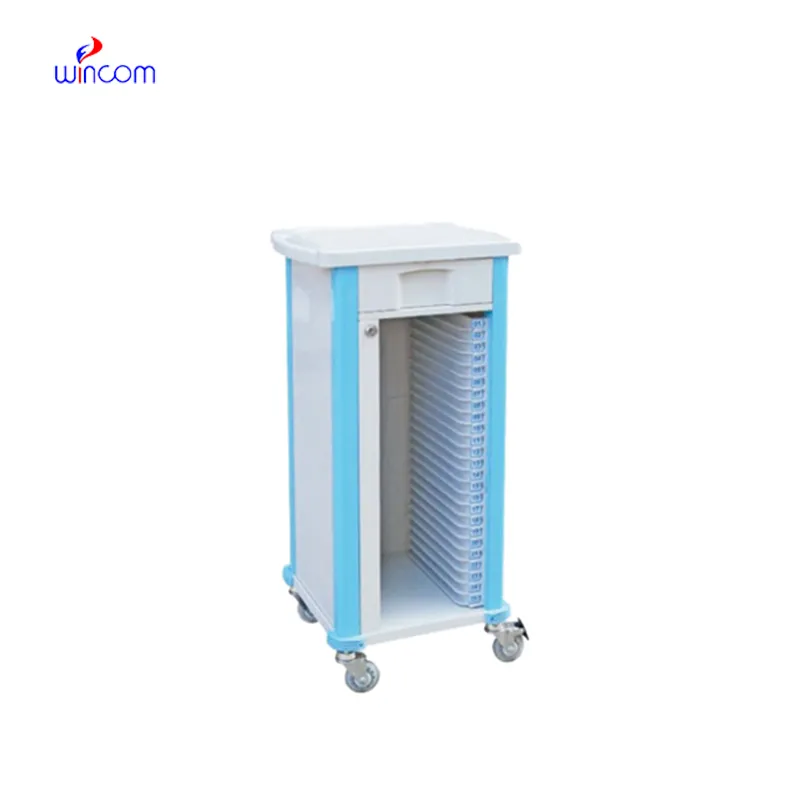
One example is this Medical Record Trolley, which can be used in hospitals, clinics, laboratories, and related care environments:
This type of trolley can be especially suitable for institutions that need a practical combination of mobility, convenience, and daily operational support.
When sourcing medical trolleys for export markets, hospitals and distributors should evaluate more than just appearance or price.
Here are a few useful questions to ask:
For distributors and procurement teams, these questions can help match products more accurately to end-user needs and improve buyer satisfaction.
There is no universal answer in the debate between open vs. covered instrument trolleys for sterile field maintenance. Each type has value. The right choice depends on what part of the workflow you want to improve.
Choose an open trolley when your priority is:
Choose a covered trolley when your priority is:
For many hospitals, clinics, and laboratories, open trolleys remain a practical and cost-effective option—especially when the trolley must support both medical organization and clinical mobility.
If you are sourcing medical trolleys for hospitals, clinics, laboratories, or healthcare distribution, we welcome your inquiry.
Contact us today for:
View product here: medical record trolley wn198-25
E-mail: [email protected]
Tel: +86-731-84176622
+86-731-84136655
Address: Rm.1507,Xinsancheng Plaza. No.58, Renmin Road(E),Changsha,Hunan,China


 EN
EN
 af
af
 es
es
 ar
ar
 tr
tr
 sw
sw
 pt
pt
 th
th
 ur
ur
 bn
bn
 ne
ne
 vi
vi
 km
km
 lo
lo
 de
de
 ru
ru
 fi
fi
 nl
nl
 fa
fa
 fr
fr
 ko
ko


