
Blog
Atomic absorption spectrophotometer, or atomic absorption spectrometer for short, is an instrument based on the principles of atomic absorption spectroscopy that is used to measure and analyze the content of specific elements in substances. It is widely used in environmental testing, food safety, geological exploration, metallurgical analysis and other fields, and is of great significance to ensuring human health and promoting economic development. This paper will discuss in detail the principle, application, technical development and future trends of atomic absorption spectrophotometer.
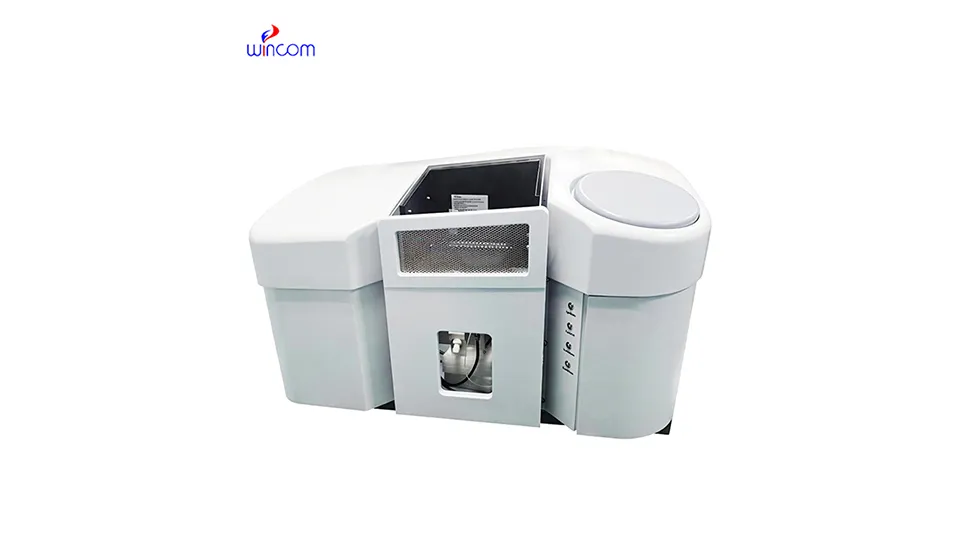
The principle of atomic absorption spectrophotometer is mainly based on the law of atomic absorption spectroscopy, that is, the ability of a specific element to absorb radiation within a certain wavelength range is proportional to its atomic concentration at that wavelength. When the light emitted by the light source passes through the atomic vapor containing the element to be measured, the ground state atoms of the element to be measured absorb light of a specific wavelength, resulting in energy level transition. By measuring the intensity of absorbed light, the concentration of the element to be measured can be calculated.
An atomic absorption spectrophotometer mainly consists of a light source, an atomization system, a monochromator, a detector and a data processing system. The light source provides light of a specific wavelength, the atomization system converts the sample to be tested into atomic vapor, the monochromator decomposes the light emitted by the light source into monochromatic light, the detector measures the intensity of the absorbed light, and the data processing system calculates the concentration of the element to be tested based on the measurement data.
Environmental testing: Atomic absorption spectrophotometer can be used to detect heavy metal elements such as lead, cadmium, mercury, etc. in the atmosphere, water and soil. These heavy metals are harmful to human health and ecological environment, so it is important to detect them accurately.
Food safety: atomic absorption spectrophotometer can be used to detect trace elements in food, such as calcium, iron, zinc, etc., as well as harmful substances such as arsenic, lead, etc. Through the detection of these elements in food, the nutritional value and safety of food can be evaluated.
Geological exploration: atomic absorption spectrophotometer can be used to analyze the elemental composition of rocks and ores, providing important data support for geological exploration and mineral resource development.
Metallurgical analysis: In the metallurgical industry, atomic absorption spectrometers can be used to analyze the element content in metals and their alloys to control product quality and reduce costs.
Improvement of light source technology: With the development of light source technology, the light source performance of atomic absorption spectrophotometer has been significantly improved. For example, using a hollow cathode lamp as a light source can improve the stability and life of the light source; using continuous light source and modulation technology can achieve simultaneous detection of multiple elements.
Innovation in atomization technology: The atomization system is one of the key parts of atomic absorption spectrophotometer. In recent years, with the continuous innovation of atomization technologies, such as the emergence of flame atomization, graphite furnace atomization, and microwave-induced plasma atomization, the sensitivity, detection limit and stability of atomic absorption spectrometers have been significantly improved.
Optimization of detection technology: The detector is a component of an atomic absorption spectrophotometer used to measure the intensity of absorbed light. With the continuous optimization of detection technology, such as the use of high-performance detectors such as photomultiplier tubes and charge-coupled devices (CCDs), accurate measurement and rapid response of weak signals can be achieved.
Upgrade of data processing technology: Data processing systems are a key part of transforming measurement data into actual results. With the development of computer technology and software technology, the data processing system of atomic absorption spectrophotometer has gradually realized automation, intelligence and remote-sensing. The data processing system can realize automatic processing, storage and transmission of measurement data, greatly improving work efficiency and data reliability.
Improvement of light source technology: With the development of light source technology, the light source performance of atomic absorption spectrophotometer has been significantly improved. For example, using a hollow cathode lamp as a light source can improve the stability and life of the light source; using continuous light source and modulation technology can achieve simultaneous detection of multiple elements.
Innovation in atomization technology: The atomization system is one of the key parts of atomic absorption spectrophotometer. In recent years, with the continuous innovation of atomization technologies, such as the emergence of flame atomization, graphite furnace atomization, and microwave-induced plasma atomization, the sensitivity, detection limit and stability of atomic absorption spectrometers have been significantly improved.
Optimization of detection technology: The detector is a component of an atomic absorption spectrophotometer used to measure the intensity of absorbed light. With the continuous optimization of detection technology, such as the use of high-performance detectors such as photomultiplier tubes and charge-coupled devices (CCDs), accurate measurement and rapid response of weak signals can be achieved.
Upgrade of data processing technology: Data processing systems are a key part of transforming measurement data into actual results. With the development of computer technology and software technology, the data processing system of atomic absorption spectrophotometer has gradually realized automation, intelligence and remote-sensing. The data processing system can realize automatic processing, storage and transmission of measurement data, greatly improving work efficiency and data reliability.
Instrument integration: With the development of micro-nano technology and manufacturing technology, atomic absorption spectrometers will become more integrated and miniaturized in the future, making it convenient for users to carry and use.
Testing automation: By introducing automation technology and artificial intelligence technology, functions such as automatic sample injection, automatic analysis, and automatic cleaning are realized to improve testing efficiency and accuracy.
Simultaneous detection of multiple elements: By optimizing light sources and detection technology, the simultaneous detection of multiple elements is realized, reducing detection costs and time costs.
Online real-time monitoring: Combine atomic absorption spectrophotometer with online monitoring system to achieve real-time monitoring and early warning of pollutants and other elements in the environment.
As an important analytical instrument, atomic absorption spectrophotometer plays an important role in the fields of environmental testing, food safety, geological exploration and metallurgical analysis. With the continuous development and innovation of technology, the performance of atomic absorption spectrometers will continue to improve and its application fields will continue to expand. In the future, atomic absorption spectrometers will play a more important role in ensuring human health and promoting economic development.
E-mail: [email protected]
Tel: +86-731-84176622
+86-731-84136655
Address: Rm.1507,Xinsancheng Plaza. No.58, Renmin Road(E),Changsha,Hunan,China


 EN
EN
 af
af
 es
es
 ar
ar
 tr
tr
 sw
sw
 pt
pt
 th
th
 ur
ur
 bn
bn
 ne
ne
 vi
vi
 km
km
 lo
lo
 de
de
 ru
ru
 fi
fi
 nl
nl
 fa
fa
 fr
fr
 ko
ko


