
Blog
Smart infusion pumps are changing medication delivery by adding software checks, drug libraries, alarms, and event data to a task that once depended mainly on manual programming. These controls can catch implausible rates or doses, identify occlusion or air-in-line conditions, and create records for quality review. For hospitals, distributors, and procurement teams, however, the real question is not whether a pump carries a smart label. It is whether the device, drug library, workflow, and training work together to reduce preventable risk.
Infusion errors can involve the prescription, preparation, programming, line setup, or alarm response. Technology can guard several steps, but it cannot validate every clinical decision or compensate for a poorly maintained medication library. A sound buying decision combines pump capability with governance, usability, and lifecycle support.
Intravenous therapy leaves little room for correction once medication enters the bloodstream. A misplaced decimal, incorrect concentration, wrong weight, or confusion between dose and flow-rate units can produce under-infusion, over-infusion, delay, or missed therapy. The U.S. Food and Drug Administration also notes that software, interface design, and mechanical or electrical failures can contribute to events, so selection must look beyond nominal accuracy.
Traditional pumps deliver the values entered by the operator. A smart pump adds context: it can compare entries with hospital-defined rules, present warnings, and retain data for review. This changes error prevention from a single bedside check into a layered process. The strongest layer still begins with the correct order, medication, concentration, patient, route, and line; the pump then helps detect inconsistencies that survive earlier checks.
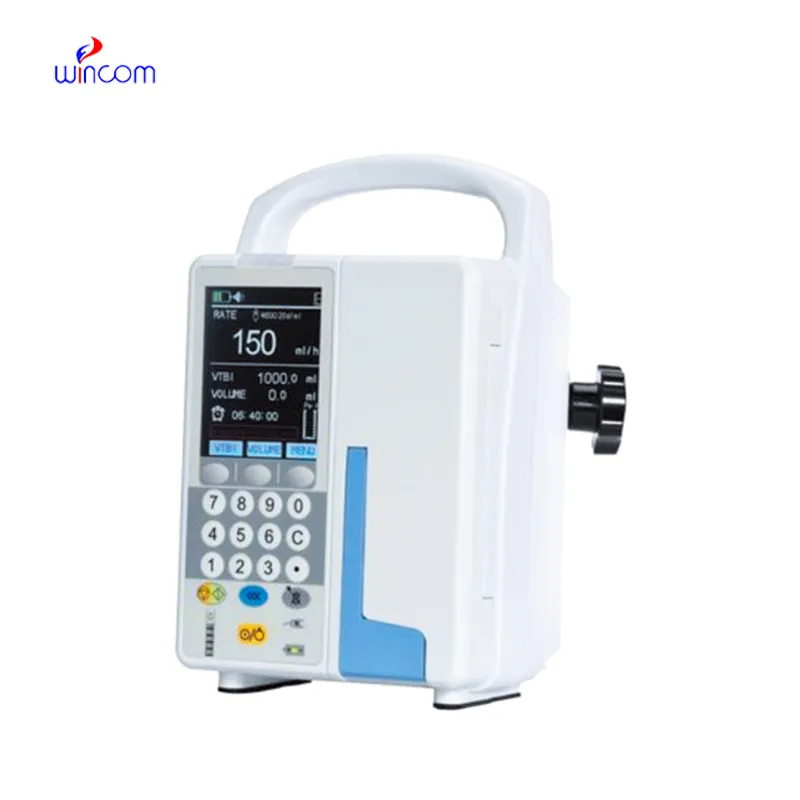
The central feature is a drug library containing standardized medications, concentrations, dosing units, and limits for specific care areas. In systems with dose error reduction software, a soft limit warns the user but may be overridden with a documented reason, while a hard limit prevents programming outside the approved range. Libraries can differ between adult intensive care, pediatrics, oncology, anesthesia, and general wards because safe parameters are not identical across populations.
Advanced deployments connect the pump with electronic prescribing, pharmacy verification, barcode medication administration, or the electronic health record. Auto-programming can transfer verified order parameters to the pump, reducing transcription, while auto-documentation can return infusion status to the record. Buyers should treat these as integration projects: compatibility, cybersecurity, network resilience, and downtime procedures need validation before go-live.
Each control addresses a different failure mode. A drug library cannot detect a line connected to the wrong patient, and an occlusion alarm cannot determine whether the prescribed dose is clinically appropriate. Hospitals gain more protection when they map each technology control to a defined verification step and assign ownership for maintaining it.
| Technology | Risk Addressed | Buyer Verification |
|---|---|---|
| Drug library | Wrong dose, rate, unit, or concentration | Confirm library capacity, care-area profiles, update process, and audit access. |
| Configurable alarms | Occlusion, air, open door, power loss, low battery | Test visibility, audibility, priority logic, and response workflow in the intended ward. |
| Infusion history | Hidden patterns and repeated workarounds | Check record capacity, export method, timestamps, and access controls. |
| Interoperability | Manual transcription and incomplete documentation | Verify supported interfaces, patient association, cybersecurity, and downtime behavior. |
Evidence reviewed by AHRQ indicates that smart pumps can prevent medication administration errors and adverse drug events, but it also identifies alert fatigue and workarounds as important implementation risks. If a library is difficult to search, limits are poorly tuned, or common medications are missing, clinicians may bypass safeguards to keep care moving. High override rates should therefore trigger investigation, not automatic blame.
A multidisciplinary team should own the library and related policies. Pharmacy validates concentrations and dosing rules; nursing tests bedside usability; biomedical engineering manages device performance; information technology supports connectivity and cybersecurity; and medication-safety leaders review event data. Updates require version control, clinical approval, staged deployment, and confirmation that every pump received the intended configuration.
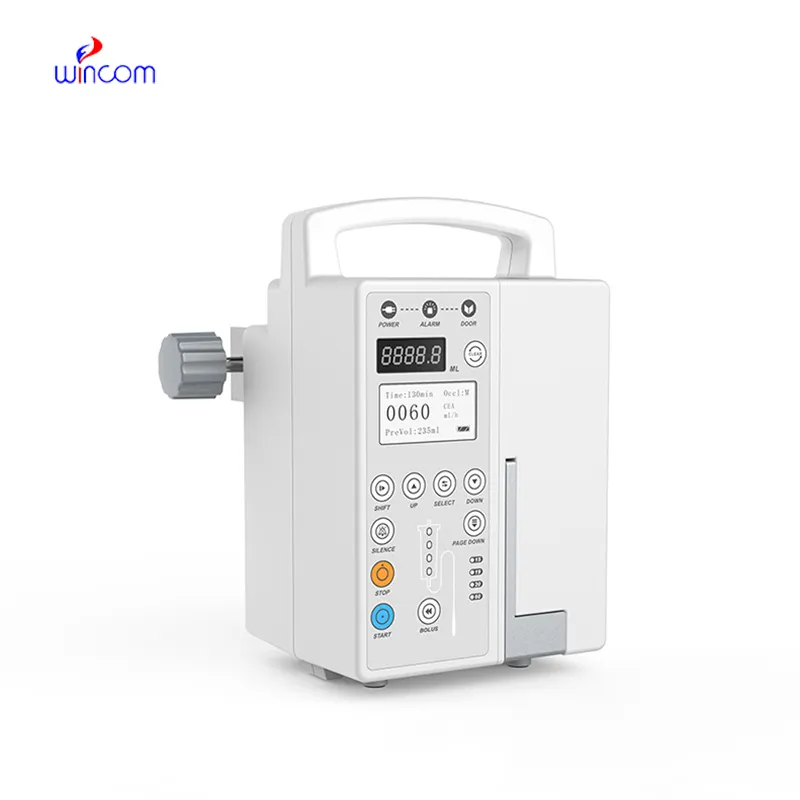
Wincom’s Infusion Pump IFP-820D is a practical option for buyers seeking a drug-library-equipped volumetric infusion pump with local traceability. It supports infusion rates from 1 to 1,200 ml/h in 1 ml/h steps, a 0 to 9,999 ml volume limit, and stated rate accuracy within ±5% after correct calibration. The pump also provides selectable occlusion-pressure levels, ultrasonic bubble detection with sensitivity of at least 25 μL, and audible and visible alerts for conditions including end of infusion, occlusion, an open door, air in the tube, incorrect settings, low battery, and AC power disconnection.
For safety review and maintenance planning, the IFP-820D adds a voice alarm system, a drug library, and storage for 2,000 infusion records. These functions can support standardized programming and retrospective review, but buyers should request a demonstration of library configuration, record retrieval, alarm behavior, supported consumables, calibration procedures, battery performance, cleaning instructions, and local regulatory documentation. The published specification does not establish EHR interoperability or dose error reduction limits, so those capabilities should be confirmed separately if required by the project.
Review Wincom IFP-820D detailsObserve workflows in target care areas, then build the drug library from approved formularies and standardized concentrations. Test a decimal error, a rate above a hard limit, a soft-limit override, occlusion, air detection, low battery, power interruption, and a library update. Include clinicians with different experience levels and high-pressure conditions.
Pilot the pumps in one unit before wider deployment. Track library use, alerts, override reasons, programming corrections, alarm response, complaints, and near misses. Combine competency checks with clear escalation routes. Review data on a fixed schedule and retire obsolete entries so the system reflects current practice.
Use acceptance testing to verify the final configured system rather than relying only on a catalog comparison. Wincom’s medical equipment portfolio and infusion-pump category can help you frame related sourcing needs, contact us for your specific quotation.
Smart pumps reduce risk; they do not make infusion error-proof. They may not catch the wrong drug selected from the library, an incorrect but still in-range patient weight, a mislabeled bag, the wrong line connection, or a clinically inappropriate order that falls within programmed limits. Excessive alerts can also normalize overrides, while outdated libraries create a false sense of security.
The safest approach is layered: standardized concentrations, pharmacy verification, patient and medication identification, independent checks for high-alert drugs, competent line setup, timely alarm response, preventive maintenance, incident reporting, and data-led improvement. Technology is most valuable when it makes the correct action easier and unusual settings more visible.
No. They can detect certain programming values and delivery conditions, but they cannot verify every order, preparation step, patient connection, or clinical judgment. They are one control within a broader medication-safety system.
A well-governed drug library is foundational because it gives the pump clinically meaningful limits. Its value depends on accurate content, easy bedside use, regular updates, and review of overrides and alerts.
Run scenario-based demonstrations with nursing, pharmacy, biomedical engineering, IT, and medication-safety representatives. Verify alarms, accuracy conditions, battery behavior, library management, records, consumables, maintenance, documentation, and any required interoperability.
Smart infusion pumps can reduce medication errors by combining standardized rules, real-time alerts, traceable data, and, where supported, connected workflows. The investment pays off when technology choices are paired with disciplined configuration, training, maintenance, and review. For an IFP-820D specification check, documentation request, or quotation, discuss the intended care area, medications, administration sets, alarm requirements, and local compliance needs with Wincom before final selection.
E-mail: [email protected]
Tel: +86-731-84176622
+86-731-84136655
Address: Rm.1507,Xinsancheng Plaza. No.58, Renmin Road(E),Changsha,Hunan,China


 EN
EN
 af
af
 es
es
 ar
ar
 tr
tr
 sw
sw
 pt
pt
 th
th
 ur
ur
 bn
bn
 ne
ne
 vi
vi
 km
km
 lo
lo
 de
de
 ru
ru
 fi
fi
 nl
nl
 fa
fa
 fr
fr
 ko
ko


