
Blog
A rotary evaporator is a commonly used instrument and equipment in the laboratory for distilling and concentrating liquids. It separates the components in the mixture by heating and rotating the container to quickly evaporate the liquid in it. Rotary evaporators are widely used in chemistry, biology, pharmaceuticals, food and other fields, and are one of the indispensable tools in laboratories.
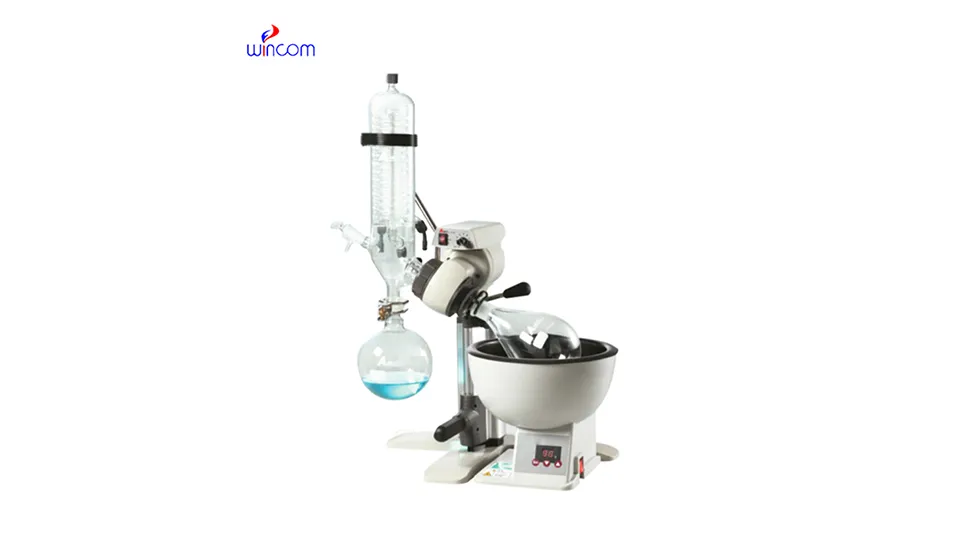
The working principle of a rotary evaporator is to use the vapor pressure difference generated by heating to form a thin film in the heated container, thereby accelerating the evaporation rate. When a liquid is heated, its molecular movement accelerates, and some liquid molecules escape from the liquid surface to form vapor. Because the density of steam molecules is small, it will spread upward. At the same time, unevaporated liquid molecules will also move towards the liquid surface under the pressure of the vapor molecules. In this way, the molecules inside the liquid continue to move towards the liquid surface and are eventually evaporated.
Rotary evaporators keep the container rotating during heating by fixing the container on a rotatable shaft. This allows the liquid to form a uniform film in the container, accelerating the evaporation rate. At the same time, rotation can also allow vapor molecules to fully diffuse in the container and improve evaporation efficiency.
1. Sample pretreatment: Commonly used for sample pretreatment, such as solvent removal, concentration, etc. For example, in drug analysis, the active ingredients in drugs need to be extracted and concentrated; in environmental monitoring, water samples, soil samples, etc. need to be pretreated.
2. Solvent recovery: It can be used for the recovery of organic solvents, reducing solvent waste and reducing experimental costs. For example, in chemical synthesis, the solvent in the reaction solution needs to be recovered; in biological experiments, solutions of biological macromolecules such as enzymes and proteins need to be concentrated.
3. Crystallization process: It can be used in the crystallization process. By controlling the evaporation rate, the solute in the solution can gradually separate out and crystallize. For example, in drug synthesis, compounds in the reaction solution need to be crystallized and purified; in biological experiments, solutions of biological macromolecules such as enzymes and proteins need to be crystallized.
1. Sample preparation: Pour the sample to be processed into the container of the rotary evaporator, taking care not to exceed the maximum capacity of the container.
2. Connecting equipment: Connect the condenser of the rotary evaporator to the cooling water circulation system to ensure the normal operation of the condenser.
3. Setting parameters: Set the temperature, speed and other parameters of the rotary evaporator according to experimental requirements.
4. Start the experiment: Turn on the heating switch of the rotary evaporator and start heating. At the same time, start the cooling water circulation system of the condenser to make the condenser work. Observe the working status of the rotary evaporator to ensure its normal operation.
5. End the experiment: When the experiment is completed, turn off the heating switch of the rotary evaporator and the cooling water circulation system of the condenser. After waiting for the rotary evaporator to cool naturally, remove the container and pour out the sample.
E-mail: [email protected]
Tel: +86-731-84176622
+86-731-84136655
Address: Rm.1507,Xinsancheng Plaza. No.58, Renmin Road(E),Changsha,Hunan,China


 EN
EN
 af
af
 es
es
 ar
ar
 tr
tr
 sw
sw
 pt
pt
 th
th
 ur
ur
 bn
bn
 ne
ne
 vi
vi
 km
km
 lo
lo
 de
de
 ru
ru
 fi
fi
 nl
nl
 fa
fa
 fr
fr
 ko
ko


