
Blog
Calibration answers one question: does this pump deliver the volume it says it delivers? On a syringe pump the answer rests on two published figures, and they measure different things. Wincom's SRP-810 is specified within plus or minus 2% mechanically and within plus or minus 3% for rate after correct calibration. That one-point gap is not margin for error; it is the syringe, the clamp and the prime. What follows is the condition set, the test points, the method and the record that make a calibration result worth trusting.
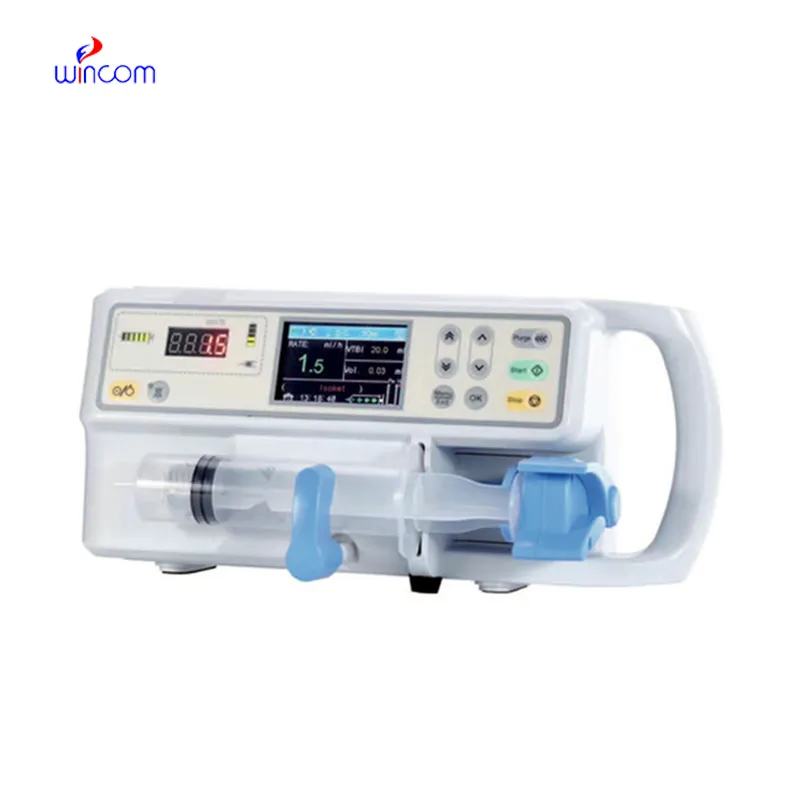
Mechanical accuracy, within plus or minus 2%, describes the drive: how closely the plunger is moved to the position commanded. It is a property of the pump, built from the motor, the lead screw and the clamp that holds the flange. Rate accuracy, within plus or minus 3% after correct calibration, describes how much fluid actually leaves the syringe over time. It includes the drive, the syringe and the line.
The distinction decides what a failure means. A pump that misses 2% has a mechanical problem to service. A pump that meets 2% and misses 3% is usually being measured with a syringe, a clamp position or a prime the calibration does not represent. Both readings can be true at once, which is why a certificate should say which figure was measured and how.
A single point at mid-range is a weak calibration. Mechanical slack and start-up error dominate at low rates, and low rates are exactly where neonatal and vasoactive infusions sit. Test the low end of the clinical range, a mid-point, and the top of the range in use, and run each point long enough for start-up to fall out of the average.
| Syringe size | Programmable rate | Step |
|---|---|---|
| 10 ml | 0.1 to 300 ml/h | 0.1 ml/h |
| 20 ml | 0.1 to 600 ml/h | 0.1 ml/h |
| 30 ml | 0.1 to 900 ml/h | 0.1 ml/h |
| 50 or 60 ml | 0.1 to 999.9 ml/h | 0.1 ml/h |
| 50 or 60 ml | 1000 to 1500 ml/h | 1 ml/h |
Low-rate work also rests on concentration standardisation, which Wincom's note on neonatal continuous infusion concentrations works through in detail.
Gravimetric testing weighs what came out and converts mass to volume using fluid density. It sees the whole chain: drive, syringe, clamp, line. Travel measurement watches the plunger move and converts distance to volume. It sees the drive only.
That difference matters more than the test equipment. The mechanical figure describes travel, so a travel-based check confirms 2% and says nothing about the 3% delivery figure. A department that calibrates by travel alone certifies the part that rarely fails. If the method is gravimetric, record balance resolution, density and evaporation control, because those three set the uncertainty of the result.
Declare the tolerance before the run, not after it. Then handle a failure in order: repeat with a new syringe of the same brand, re-check clamp and plunger seat and look for a partial occlusion or a compliant tube, and if two runs fail the same point, take the pump out of service with the reading, the syringe lot and the conditions written down.
The record is the deliverable. It should carry the pump serial number, the method, the syringe specification, the test points, the measured volumes, the tolerance applied, the reference used for the balance or weights, the technician, the date and the next due date. A certificate stating a pass without test points cannot be audited or repeated.
Repeatable results need a device that accepts the syringes you use, states its limits per size and holds the flange the same way every time. Inside the syringe range the choice comes down to rate envelope and audit features, and the SRP-900B is the model to weigh against the SRP-810 before you specify.
When the therapy needs more volume than a syringe holds, the question changes from accuracy per millilitre to continuous delivery: a volumetric pump runs 1 to 1200 ml/h, and the infusion and syringe pump range puts both classes side by side.
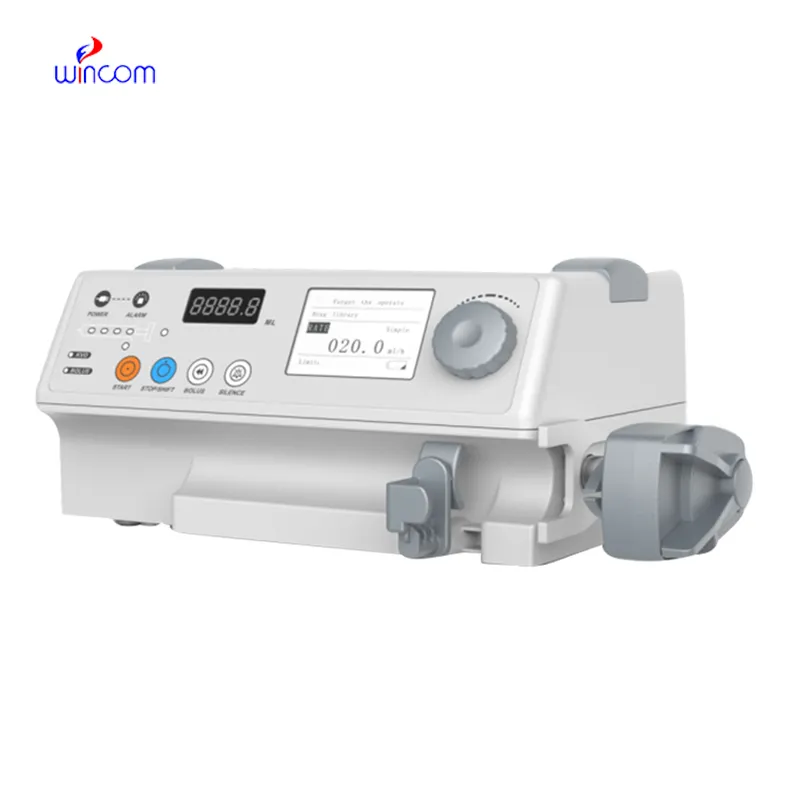
⭐ Recommended Syringe Pump | Wincom SRP-810
Wincom's Syringe Pump SRP-810 is positioned for wards, theatres and ICUs delivering small-volume and low-rate infusion, with size-specific rate limits running from 0.1 to 300 ml/h on a 10 ml syringe up to 0.1 to 999.9 ml/h on a 50 or 60 ml syringe in 0.1 ml/h steps, rate accuracy within plus or minus 3% after correct calibration, mechanical accuracy within plus or minus 2%, and a voice alarm system. This makes it useful where accuracy has to be demonstrated rather than assumed, because the two figures separate a drive fault from a syringe or setup effect. Where the calibration record has to sit beside an audit trail, the SRP-810D adds a drug library and storage for 2,000 injection records.
Calibration only holds when the pump, the syringe and the record agree.
Send the syringe brands and sizes your wards use, the rate range and the tolerance your quality system applies. Wincom will confirm which SRP-810 limits apply per size and what documentation ships with the unit.
Contact UsMechanical accuracy covers the drive and is stated within plus or minus 2%. Rate accuracy covers delivered volume and is stated within plus or minus 3% after correct calibration. The gap belongs to the syringe, the clamp and the prime.
The specification does not set an interval. Local policy and the supplier's recommendation do, so confirm both in writing, and shorten the interval after any failed check or a change of syringe brand.
Only if that syringe is the one in clinical use. Plunger friction and flange dimensions differ between brands, so a result produced on a different syringe cannot be transferred to the ward.
No. Calibration covers delivery accuracy only. Alarm function, battery behaviour and the drug library content need separate checks before the pump returns to a patient.
E-mail: [email protected]
Tel: +86-731-84176622
+86-731-84136655
Address: Rm.1507,Xinsancheng Plaza. No.58, Renmin Road(E),Changsha,Hunan,China


 EN
 af
 es
 ar
 tr
 sw
 pt
 th
 ur
 bn
 ne
 vi
 km
 lo
 de
 ru
 fi
 nl
 fa
 fr
 ko


