
Blog
Portable syringe pumps can help patients move beyond the bedside while maintaining a controlled infusion. That matters during early mobilization, diagnostic transfers, rehabilitation, and movement between departments. Yet portability is not simply a small enclosure or handle. A mobile setup must keep therapy continuous, the syringe secure, the line protected, alarms visible or audible, and the patient appropriately supervised.
For hospital buyers, biomedical engineers, nursing leaders, and distributors, the practical question is whether the complete pump-and-line system can travel without avoidable interruption, programming, power, or handling risks. This guide evaluates portable syringe pumps around that broader goal.
When clinically appropriate, getting a patient out of bed may support rehabilitation, toileting, imaging, ward transfers, and a less restrictive care experience. A syringe pump can support that movement because it delivers medication or fluid from a compact syringe.
The pump does not make every patient independently mobile. The drug, vascular access, monitoring requirements, fall risk, cognitive status, and hospital policy still determine how movement should occur. Mobility may mean walking with staff, sitting in a chair, moving on a wheelchair, or traveling on a stretcher. A useful procurement specification starts by defining these scenarios instead of using the vague requirement "portable."
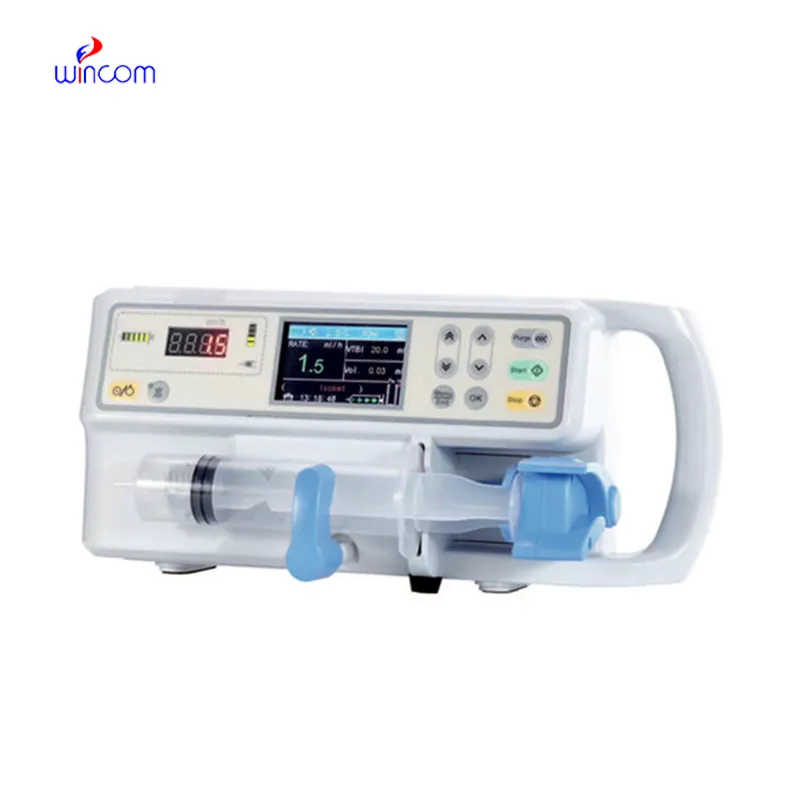
A portable design must work as a system. Size and weight influence handling, while battery endurance, mounting security, display readability, alarms, syringe compatibility, and cleaning shape mobility. A pump that is easy to lift but difficult to attach safely may add transfer risk. Battery endurance also has limited value without a clear charge display.
Map each feature to an action. Ask whether staff can move the assembly without pulling the line, whether the clamp resists rotation, whether controls can be locked, and whether alarms remain recognizable in a corridor. Include the pole, dock, power adapter, and cable management because accessories often determine practical portability.
| Evaluation area | What to verify | Why it matters |
|---|---|---|
| Power | Battery runtime, recharge time, status display, low-battery warning | Protects continuity when mains power is unavailable |
| Mounting | Clamp range, rotation resistance, rail or pole fit, release method | Reduces drops, tipping, and line tension during movement |
| Interface | Screen visibility, key lock, confirmation steps, alarm history | Helps staff recognize the active program and avoid unintended changes |
| Syringe setup | Supported brands and sizes, detection method, secure loading | Limits mismatch and setup uncertainty |
| Transport | Weight, dimensions, handle, accessories, cable management | Determines how the complete system moves through doors and elevators |
| Hygiene | Surface materials and approved cleaning agents | Supports turnover without damaging labels or controls |
Transitions deserve the most attention: disconnecting mains power, moving from a wall rail to a pole, passing through doors, and reconnecting at the destination. Before movement, confirm the patient, medication, concentration, rate, remaining volume, vascular access, line routing, battery, alarms, and destination power source.
Provide enough managed line slack without loops that can snag. Keep the pump and access site visible when possible. At arrival, confirm that the infusion continues as intended and document any interruption under local policy. These checks matter more than transfer speed.
Battery performance sets the boundary for off-mains operation. Evaluate usable runtime under expected settings, not only a nominal figure. Ask how aging, temperature, charging, and alarms affect performance and how maintenance verifies battery condition.
Users must understand occlusion, near-empty, empty, syringe displacement, system error, and low-battery alarms before mobile operation. Verify alarm priority, volume, visual indicators, silence behavior, and event records during acceptance testing. A clear display, deliberate confirmation sequence, and control lock can reduce ambiguity while the environment changes.
In an ICU, portability may support imaging or a bed transfer with several devices attached. In a general ward, it may support supervised walking or chair use. Neonatal and pediatric care places extra emphasis on protocol, syringe selection, line management, and monitoring. Wincom's article on standardized neonatal and infant continuous infusions adds context for low-volume workflows.
Build a use-case matrix that lists department, typical therapy duration, syringe sizes, mounting location, transfer distance, monitoring level, and cleaning frequency. Compare candidate pumps against those actual pathways. This is more useful than selecting one model around a single maximum value, because mobility depends on how features work together during repeated daily use.
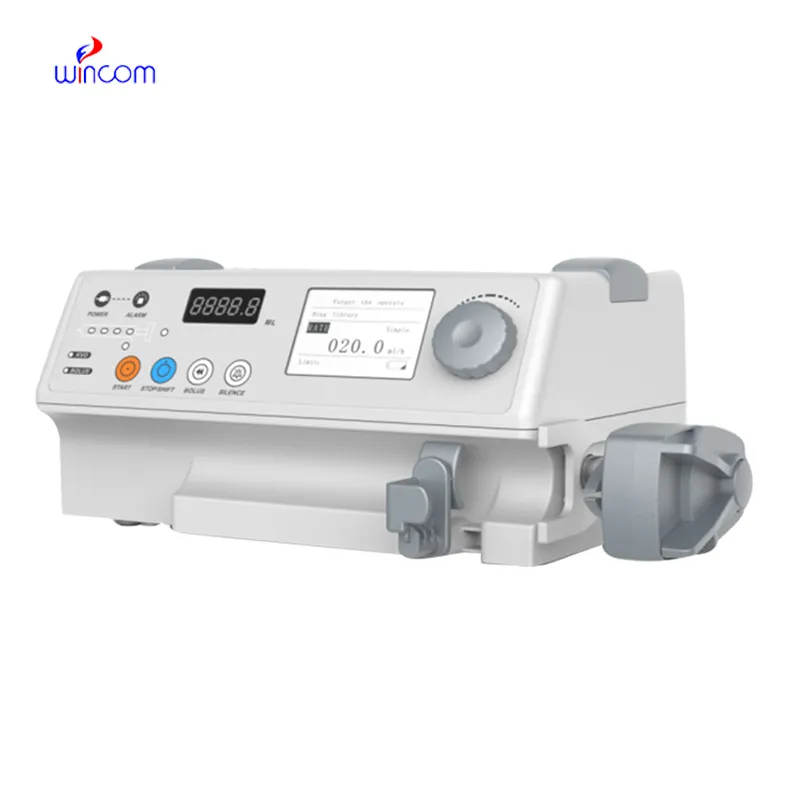
The Wincom Syringe Pump SRP-810D combines broad syringe compatibility with safety and data-management functions.
These functions distinguish the SRP-810D from a basic pump. Confirm battery runtime, mounting, accessories, and market documentation.
A pump does not travel alone. The pole, bed, wheelchair, stretcher, and power arrangement determine stability and reach. Review infusion support options alongside the pump, especially where devices share one stand. Check center of gravity, wheels, brakes, pole diameter, clamp position, cables, and door clearance.
Standardized mounting positions reduce variation, while labels identify approved configurations. Biomedical engineering should assess electrical safety and compatibility; nursing should test handling; infection prevention should review cleaning; and procurement should match quoted accessories to the evaluated setup.
Training should reproduce pressure points. Users need practice moving to battery power, securing approved supports, managing lines, responding to corridor alarms, handing over, and returning the device to charge. Competency checks should distinguish routine transport from situations requiring additional support.
Facilities should also define who may change settings during transfer and what to do if the pump is dropped, exposed to fluid, shows unexpected behavior, or cannot complete the journey on battery. Refresher training can use incident reports, alarm trends, and maintenance findings to focus on real weaknesses. Mobility improves care only when staff can preserve the same medication safeguards used at the bedside.
Portable syringe pumps can reduce the physical restriction created by continuous infusion, but mobility is an outcome of good system design rather than one product label. The strongest programs align device features, accessories, staff competency, maintenance, medication policy, and transfer procedures around clearly defined patient pathways.
When comparing models, start with the journey: where the patient will move, how long power may be unavailable, who will supervise, what equipment travels with the pump, and how therapy will be verified before and after transfer. Then qualify the device against those conditions. This approach helps hospitals pursue greater patient mobility without treating infusion continuity as a secondary concern.
No. Mobility depends on therapy, vascular access, monitoring, clinical condition, fall risk, and facility policy. The care team determines the appropriate supervision and method.
No single specification is enough. Battery performance, secure mounting, alarm behavior, syringe compatibility, interface controls, weight, and accessory configuration should be evaluated together against the intended transfer workflow.
Use it as a screening input, then confirm test conditions and verify performance during acceptance and preventive maintenance. Battery age, settings, charging practice, and operating conditions can affect usable runtime.
Provide the target country, clinical departments, expected syringe sizes, use scenarios, transfer duration, mounting system, power standard, required language, quantity, documentation needs, and requested accessories. This gives Wincom enough context to respond with a more precise configuration and quotation.
Send Wincom your clinical use cases, configuration requirements, destination market, and documentation checklist to request current model information and a quotation.
Clinical note: Device selection, programming, transport, monitoring, and maintenance must follow the manufacturer's current instructions and the healthcare facility's approved policies.
E-mail: [email protected]
Tel: +86-731-84176622
+86-731-84136655
Address: Rm.1507,Xinsancheng Plaza. No.58, Renmin Road(E),Changsha,Hunan,China


 EN
EN
 af
af
 es
es
 ar
ar
 tr
tr
 sw
sw
 pt
pt
 th
th
 ur
ur
 bn
bn
 ne
ne
 vi
vi
 km
km
 lo
lo
 de
de
 ru
ru
 fi
fi
 nl
nl
 fa
fa
 fr
fr
 ko
ko


